Custom VR module development
VR should be used because it improves the learning opportunity, not simply because it is engaging. ELN Game Studio develops immersive modules for situations where learners benefit from being inside an environment, making decisions, interacting with equipment, repeating a process or observing consequences that would be difficult, expensive, disruptive or unsafe to reproduce in the real world.
Our VR development is grounded in education and workplace practice. Learning objectives, user guidance, feedback, accessibility, performance and transfer into real activity are considered from the beginning. Where nationally recognised training is involved, the VR module supports learning and practice; assessment and certification remain the responsibility of the relevant RTO or TAFE.

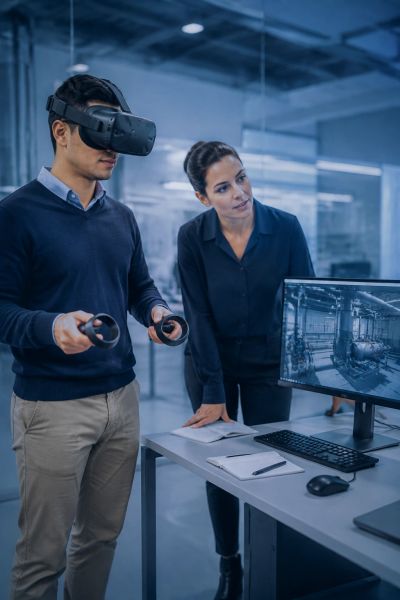
What a VR module can include
- A realistic or stylised workplace, facility, workshop or operational environment
- Guided induction, orientation or familiarisation before entering the real environment
- Hazard recognition, TAKE 5 processes and safety decision-making
- Fabrication machines, tools, equipment and procedural practice
- Interactive characters, supervisors or T.R.Dee™-style learner guidance
- Branching decisions, visible consequences and meaningful feedback
- Knowledge checks, demonstrations, repeated practice and project-based activities
- Desktop spectator or facilitator views to support group delivery
- Companion eLearning, SCORM content, learner resources and assessment links
- Analytics, completion evidence and implementation support where appropriate
VR Development Services
- Learning and performance analysis
- Concept development, scripting and storyboarding
- Environment, interaction and user-experience design
- 3D asset creation and optimisation for VR performance
- Unity development and headset-ready module production
- Voiceover, character guidance, sound and visual feedback
- Accessibility, comfort and usability considerations
- Technical quality assurance and device testing
- Learner, educator and workplace user testing
- Deployment planning, facilitator guidance, updates and maintenance
When immersive learning adds value
VR is particularly useful when access is limited, the real environment is hazardous or costly, learners need repeated practice, spatial understanding matters, or decisions and consequences are central to performance. It may not be the right answer when a short explanation, demonstration or supervised real-world activity would achieve the outcome more effectively.
Our role is to make that distinction honestly. We may recommend a VR module, a digital twin, conventional learning, or a blended pathway that moves from knowledge to immersive practice and then into the real workplace.

How we work
Discover — Clarify the intended outcome, audience, work environment, constraints, evidence requirements and measures of success.
Design — Map the learner journey, interactions, content, decisions, feedback and relationship with real practice or assessment.
Develop — Create the learning resources, immersive environment, module, assessment system or connected solution.
Test — Review technical performance, usability, learning clarity and user response with relevant learners and stakeholders.
Deliver — Support implementation, facilitators, deployment, communication and the transition into normal operations.
Improve — Use evidence, feedback and observed performance to refine the solution and plan the next iteration.
Evidence in Practice
Tradiecraft® demonstrates this approach. Across three trials and one workplace implementation, 80 learners and workers participated in testing and delivery. Feedback led to clearer learning objectives, stronger learner guidance, improved progression, greater emphasis on decisions and consequences, and better connections between immersive practice and real learning activity.
The evidence is presented carefully. It shows feasibility, learner response and the value of iterative development; it is not positioned as universal proof that VR improves every learning outcome.